

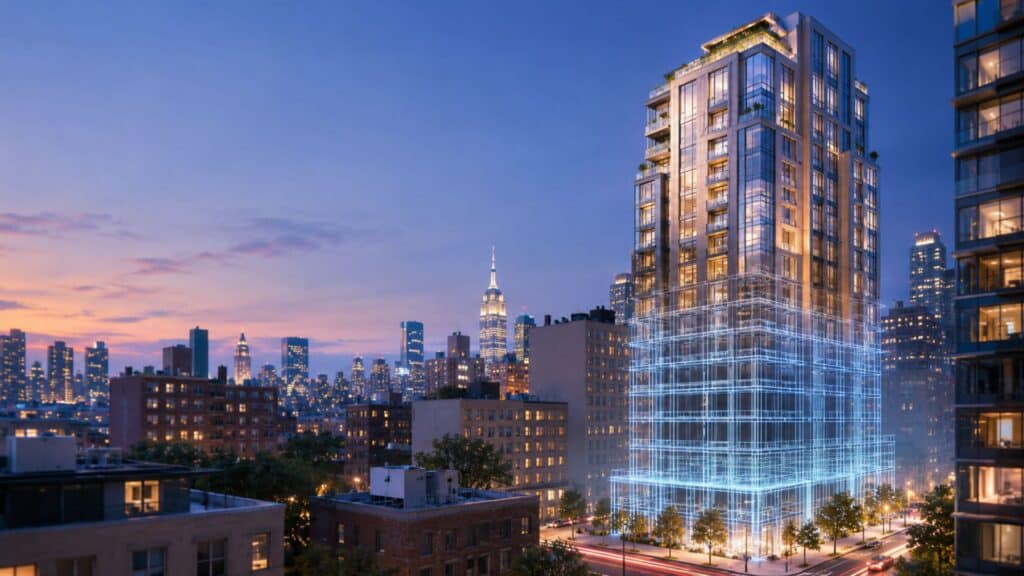
New York developers have to sell a building long before anyone can stand in it. Buyers, lenders, equity partners and neighbors are all asked to judge something that exists only as drawings. Pre-construction animation closes that gap by showing the finished project in motion, at street level and inside the units.
This guide explains what pre-construction animation is, why it matters in today’s market, and how to commission it. It also covers the New York offering rules that shape what your film can show.
What Is Pre-Construction Animation?
Pre-construction animation is a computer-generated film of a project that has not been built. Artists create a 3D model from the architect’s drawings, add materials, light and landscaping, then move a camera through it.
A rendering shows one fixed view. A film shows a sequence: the arrival, the lobby, the walk to the elevator, and the view opening up from a terrace. Viewers get a sense of how the spaces connect, which is hard to convey with stills.
| Format | Shows best | Typical use |
| Walkthrough | Room flow, finishes, scale | Buyer presentations |
| Flythrough | Exterior, site, neighborhood context | Investor and launch films |
| Cinematic film | Story, mood, lifestyle | Flagship launches |
| 360 virtual tour | Viewer-led exploration | Websites and sales galleries |
| Still rendering | One strong view | Brochures, listings, ads |
Most campaigns combine several of these, and they can often draw on the same 3D model.
Why Pre-Construction Animation Matters in New York Now
New supply is arriving in a market where contract signings have slowed, so new projects need to stand out. Manhattan saw 240 new development contracts in Q3 2026, down 27% from 331 a year earlier, according to Brown Harris Stevens Development Marketing. The firm cautions that not all contracts were reported.
The pipeline is moving the other way. Manhattan’s rose 40% to 3,796 units, and 768 units were expected to launch in Q4, though not all publicly. Brooklyn’s pipeline stands at 2,139 units, up 5%.
About 70% of Manhattan’s Q4 pipeline sits in four areas: Downtown West, the Upper East Side, and East and West 14th to 34th Streets. Several launches may therefore compete for the same buyers in the same neighborhoods. In that setting, pre-construction animation gives a sales team a clear way to show what makes one building different.
Public review is changing too. Voters approved City Charter amendments in November 2025 that create faster paths for some housing projects. Formal ULURP takes about seven months, while the new expedited procedure halves public review time for covered applications, according to the Charter Revision Commission. Community Board review stays in place, so eligible projects may need their presentation materials ready sooner.
Where Pre-Construction Animation Earns Its Budget
The strongest return usually comes when one film serves several audiences. Plan for each of these before production starts.
- Buyers and brokers: Show finishes, room flow and amenities in a form that is easy to share.
- Sales galleries: Run the film on large screens beside physical finish samples and models.
- Investors and lenders: Show massing, site access, phasing and neighborhood fit in a few minutes.
- Community boards: Show how a building meets the street and sits among its neighbors, in terms non-specialists can follow.
- Digital campaigns: Cut shorter vertical and square versions for ads and social channels.
Pre-construction animation will not fix weak pricing or poor positioning. What it can do is make an unbuilt project easier to understand and easier to pass along.
How Pre-Construction Animation Is Produced
Most studios follow a similar path, and each approval stage makes later changes cheaper to avoid.
- Brief: Define the audience, the runtime, the key selling points and every format you need.
- Source files: Share CAD or BIM models, elevations, finish schedules and landscape plans.
- Storyboard: Approve the script, the shot list and the camera path.
- 3D modeling: Build the building, the interiors and the surrounding context.
- Previews: Review clay renders, material tests and a low-resolution cut.
- Final render: Lock the lighting, materials and motion, then render at full quality.
- Post-production: Add music, voice-over, graphics, required legends and cutdowns.
New York Rules That Shape Your Film
For condo sponsors, pre-construction animation used to market units should be treated as advertising. New York’s rule for new condominiums covers advertising “in print or other media,” and a legal review belongs in the schedule.
- Label renderings: An artist’s rendering must be marked as one.
- Depict the site accurately: Dimensions, height, landscaping, and surrounding roads, buildings and open space must be realistic.
- Keep plans to scale: Any room or floor plan must be to scale.
- Match the offering plan: Advertising must be consistent with it, and factual claims must be demonstrably true.
- Disclose amenity timing: Amenities not available at closing need an approximate availability date, and extra fees must be mentioned.
- Include the legend: The film needs the required statement that full terms are in the offering plan, shown or clearly spoken.
Timing matters as well. A sponsor must have its offering plan accepted for filing before offering or selling units, and the Attorney General’s office responds within 30 days of submission. A disclaimer will not rescue an inaccurate film, because sponsors cannot disclaim liability for representations that contradict the plan.
This summary is general information, not legal advice. Co-ops and conversions fall under different parts of the rules, so ask your offering plan attorney to review the film before release.
How to Choose a Pre-Construction Animation Studio
Look for property experience first, because architecture demands accuracy that general animation reels may not prove. For a broader checklist, see what makes a great animation studio. If your partner is based elsewhere, read about hiring a remote animation studio from New York.
- Relevant work: Ask for urban, multifamily or mixed-use films, not only villas.
- New York context: Check how the studio handles dense streets, neighboring buildings and views.
- Clear approvals: The proposal should name each review stage and the number of revision rounds.
- Defined scope: Confirm whether interiors, context, music, 4K delivery and cutdowns are included.
- Usage rights: Confirm who owns the 3D model and the final files.
Common Mistakes to Avoid
- Starting too late: Treating pre-construction animation as the last marketing task leaves no room for review.
- Filming an unstable design: Late changes after lighting and camera approval are costly.
- Flattering the context: Removing neighboring buildings or inventing views creates legal and credibility risk.
- Skipping the cutdowns: Plan short edits at the storyboard stage, not after the final render.
What Pre-Construction Animation Costs
Expect a wide range, because scope matters more than runtime. One studio’s 2026 pricing guide lists walkthroughs from about $2,200 per finished minute to $12,000 or more, with high-end cinematic films costing significantly more. These are published studio figures, not New York quotes, so use them only as a starting point.
| Project type | Typical runtime | Budget level |
| Apartment interior walkthrough | 30 to 45 seconds | Lower |
| Residential development film | 60 to 90 seconds | Middle to high |
| Luxury cinematic film | 90 seconds or more | High |
The biggest cost drivers are the amount of modeling, the level of realism, the number of scenes, revision rounds and delivery formats. Production timelines vary in the same way. The same guide says a simple walkthrough can take a couple of weeks, while a detailed film may take several weeks or longer.
To control the budget, supply clean source files, approve the camera path early, and separate must-have shots from nice-to-have ones.
Frequently Asked Questions
How long should a pre-construction animation be?
Most residential development films run 60 to 90 seconds. Add shorter cuts for ads and social channels, and keep a longer version for investor meetings.
When should a developer commission pre-construction animation?
Start once the massing and key finishes are stable, and leave enough time for legal review before launch.
Can pre-construction animation be used at community board meetings?
Yes, as a supporting visual alongside your formal application materials. Keep the height, massing and surrounding buildings accurate, because local reviewers know the block well.
Can the film be updated if the design changes?
Usually, because the studio can revise the existing 3D model. Changes made after final approval will still add time and cost.
Make Your Project Easy to Picture
In a market with more launches ahead, the developers who explain their buildings clearly have an advantage. Well-planned pre-construction animation can do that for buyers, investors and neighbors from a single 3D model.
Start with your launch date and work backward. Build in time for approvals and offering plan review, then brief a studio on the decision each audience needs to make. If you are planning a New York launch, contact our team to scope your pre-construction animation.