

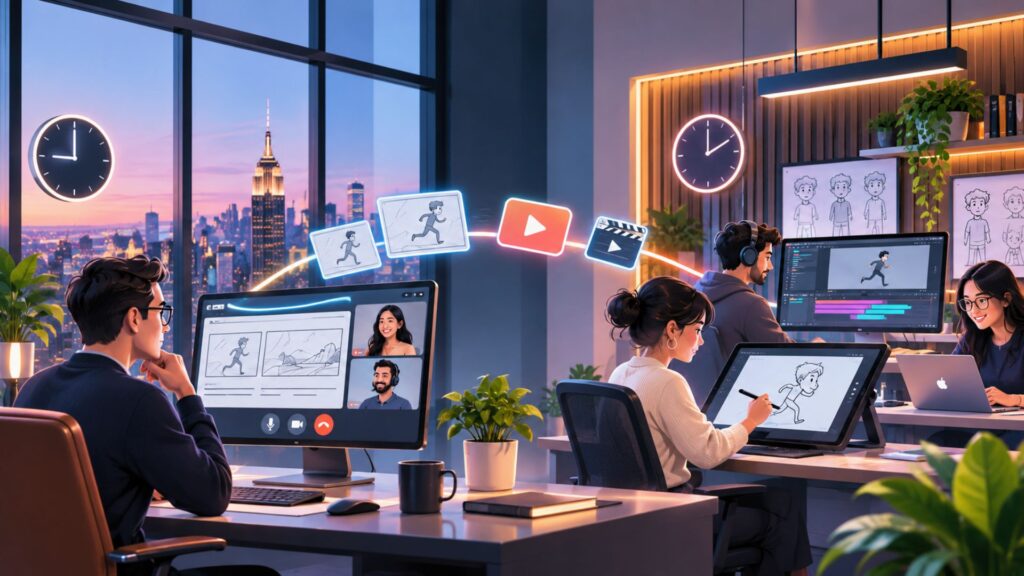
Hiring a remote animation studio from New York can give you a wider choice of styles and, with an overseas team, rates 30% to 50% lower. Expect to spend about $5,000 to $25,000 on a custom 60-second explainer, and to wait six to eight weeks for it.
You will also approve the work in stages, over video calls and shared review links. This guide explains what a remote animation studio will charge, how the work runs, and what your contract should cover.
Why New York businesses hire a remote animation studio
A remote animation studio lets you choose talent by style rather than by ZIP code. Reputation, style, and turnaround matter more than city, so a local address doesn’t guarantee better work.
- Style fit: You can pick a team that specializes in your look, such as 3D product work or 2D characters.
- Budget: North American studios bill about $100 to $250 an hour. Eastern European and Asian teams cost 30% to 50% less, but they may need more oversight.
- Capacity: An outside team can take on campaign work without adding to your payroll.
Going remote has a trade-off: you lose casual in-person check-ins, so the process has to be written down. A good remote animation studio expects this and sets it up from day one.
What a remote animation studio costs
Most studio quotes for custom work start at about $5,000 per finished minute. One 2026 market survey found a median quote of $9,680 for a custom 60-second explainer, based on 61 usable quotes.
| Provider | Price per finished minute | Best fit |
| Freelancer | 1,000–5,000 | Simple, clearly defined projects |
| Small or midsize studio | 5,000–8,000 | Custom explainers and marketing videos |
| Established studio | 8,000–25,000 | Complex or high-profile brand work |
| Broadcast-level studio | $25,000+ | Broadcast productions |
These ranges come from a studio’s own pricing guide, so treat them as a starting point rather than a rate card.
Compare quotes line by line. Ask whether each remote animation studio includes the script, storyboard, voiceover, and sound design, because these can change what a quote covers. Also ask about revisions: two consolidated rounds is the common standard, and some studios charge $500 to $1,000 for each extra round.
How the production process and timeline work
A standard custom explainer takes about six to eight weeks including review time, and rush projects take about three to four weeks. Stage names vary, but most remote animation studio teams follow a sequence like this one:
- Kick-off (1 day): You complete a creative brief and join a call.
- Script (2–3 days): You approve the script.
- Storyboard (about 1 week): You approve the scene-by-scene plan.
- Voiceover (about 1 day): The narration is recorded.
- Style frames (2–3 days): You approve the visual direction, often while the storyboard is underway.
- Illustration (about 1 week): You approve the final artwork.
- Animation (about 1 week): You approve the motion.
- Music and sound (1–2 days): You approve the final mix.
These are one studio’s working times, and some stages overlap. Each major delivery also needs about one to two days of your review, which adds at least eight days across the project.
Style changes the schedule too:
| Style | Typical length | Timeline |
| Whiteboard or line art | 60 seconds | 4–5 weeks |
| 2D flat or motion graphics | 60 seconds | 5–6 weeks |
| 2D character animation | 60–90 seconds | 7–9 weeks |
| Mixed media or live action | 90 seconds | 8–12 weeks |
| 3D animation | 60 seconds | 10–14 weeks |
Give your toughest feedback early. One agency estimates that a change taking 10 minutes at the script stage takes about 10 hours during animation.
How time zones and communication work
The time difference sets your feedback rhythm, so settle it before you sign. A remote animation studio in Europe shares your morning, while one in Asia works as New York sleeps.
| Studio location | Difference from New York | Live overlap |
| Los Angeles | 3 hours behind | Most of the workday |
| Buenos Aires | 1–2 hours ahead | Most of the workday |
| London | 5 hours ahead | New York morning |
| Warsaw | 6 hours ahead | New York morning |
| Manila | 12–13 hours ahead | Early morning or evening in New York |
A few habits keep the work moving:
- Name one approver: Give one person final authority, since committee feedback is a common cause of delays.
- Set review windows: Agree that you will reply to each delivery within one to two days.
- Write feedback down: Use timestamped notes on the review link, so nothing gets lost overnight.
- Book one weekly call: Hold it inside your shared hours.
Delays compound across time zones. With a 12-hour gap, one unanswered question can cost a remote animation studio a full working day.
What your contract should cover
Sign a written contract before work starts, because payment alone doesn’t transfer copyright. Your agreement with a remote animation studio should cover:
- Scope: Video length, style, file formats, and the number of revision rounds.
- Payment: Amounts tied to approved milestones, with due dates.
- Ownership: A signed work-made-for-hire clause, plus a backup copyright assignment.
- Source files: Whether you receive the editable project files, or only the finished video.
- Licenses: Rights to music, voiceover, and stock assets for every place you plan to use them.
- Subcontractors: Confirmation that anyone working on the project has signed over their rights.
- AI tools: Where AI is used. The U.S. Copyright Office’s January 2025 report says human authorship remains the cornerstone of copyright protection, so this may affect what you can protect.
Hiring a solo animator brings a New York rule into play. Since August 28, 2024, the Freelance Isn’t Free Act has required a written contract for freelance work of $800 or more, counting contracts with the same hiring party in the prior 120 days.
Under that law, you pay by the agreed date, or within 30 days of completion if no date is set. You also keep the contract for at least six years. The law covers individuals and one-person organizations, so a staffed remote animation studio generally falls outside it.
This is general information, not legal advice. Ask an attorney to review your contract, especially if the team is overseas.
How to vet a remote animation studio
Judge each studio on finished work like yours and on how it runs a project, not on its showreel alone. Ask these questions on your first call:
- Can you show two or three complete videos in the style we want?
- Who will be our day-to-day producer?
- Will your staff do the work, or will you use subcontractors?
- What does the quote include, how many revision rounds do we get, and what does an extra round cost?
- Which hours will you be available during the New York workday?
Watch for these red flags:
- A very fast custom promise: Under three to four weeks for a 60-second video may mean a template with your logo added.
- “Unlimited” revisions: Open-ended terms are worth questioning, so ask for the exact number of rounds.
- A single price with no breakdown: You can’t compare it with other quotes.
- Vague ownership terms: Get them in writing before any work begins.
Frequently asked questions
Is a remote animation studio cheaper than a local one?
Not always. US and Canadian studios price similarly, so the bigger savings usually come from Eastern European or Asian teams.
How long does a 60-second animated video take?
Expect about five to six weeks for 2D motion graphics and 10 to 14 weeks for 3D.
Who owns the finished video?
You own it only if the signed contract says so. Use work-made-for-hire language with a backup assignment, and sign before work begins.
How much of my time will the project take?
Plan to review each major delivery within one to two days. Those reviews add at least eight days across a standard project.
Choosing the right remote animation studio
A clear scope, one approver, and signed ownership terms will do more for your project than a New York address. Collect two or three quotes, compare them line by line, and choose the remote animation studio whose process fits your schedule.